Reality Checks / 02
Reality Check 02
The Economics of the Two-Week Girlfriend
The relationship may be real. The economics are real too. Those facts are not mutually exclusive.
It normally begins with dinner.
Nothing dramatic.
Two people meet.
They eat.
He pays.
The bill is small enough that he does not think about it.
The next day they meet again.
Lunch.
Taxi.
Coffee.
Maybe drinks later.
He pays again.
Still nothing dramatic.
By Day Four she is staying at his hotel.
By Day Six the receptionist knows her.
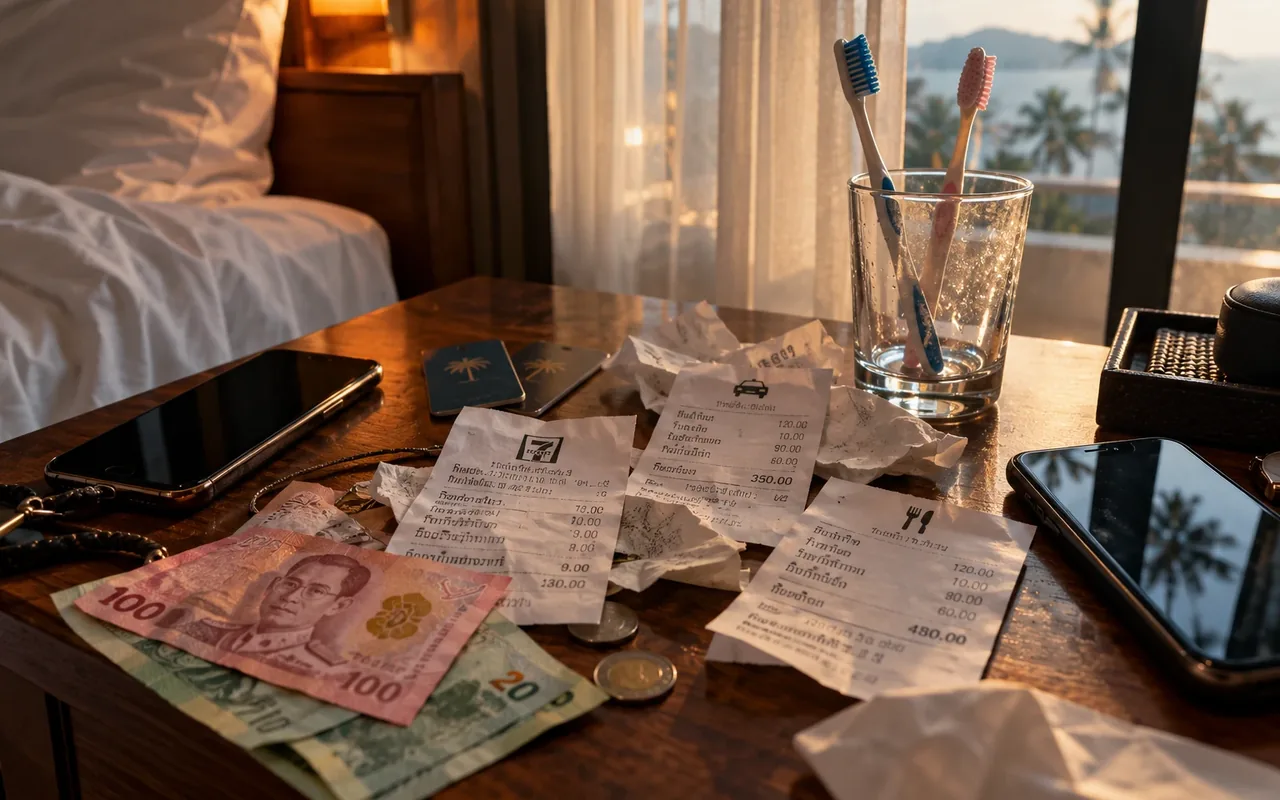
By Day Eight there is a second toothbrush beside the sink.
By Day Ten she refers to the hotel room as “our room.”
At no point did anyone hold a meeting.
The relationship simply expanded.
So did the spending.
220 baht.
480 baht.
1,350 baht.
700 baht.
2,100 baht.
Nothing large enough to feel like a financial decision.
Which is precisely why holiday relationships can become expensive without ever containing one obviously expensive moment.
Holiday Money Is Not Normal Money
A visitor arrives with a temporary budget.
He has already accepted that the trip costs money.
Hotel.
Flights.
Motorbike.
Restaurants.
Beach clubs.
Activities.
A few thousand baht disappears every day and feels normal because he is on holiday.
The person he meets enters this financial environment.
Suddenly meals for one become meals for two.
Grab becomes two seats.
Trips become shared.
Shopping becomes easier to justify.
A charger appears.
Then cosmetics.
Then perhaps money for something at home.
The shift rarely happens with one dramatic request.
It happens through accumulation.
The Income Gap
This is the part people often discuss badly.
A foreign visitor may spend in one evening what another person earns over several working days.
That creates a financial imbalance even when both people have good intentions.
What feels trivial to one person may feel significant to the other.
This affects expectations.
It affects generosity.
It affects what counts as “a lot of money.”
And it affects how quickly support becomes normal.
None of this proves that someone is being used.
It simply means the relationship exists inside an economic reality.
Ignoring that reality does not make the relationship more romantic.
It makes the participant less informed.
The Opportunity Cost
Time has value too.
If somebody changes their normal schedule to spend nearly every day with a visitor, there may be an economic cost.
Work is missed.
Other plans disappear.
Income opportunities may disappear.
The tourist experiences this as:
“She wants to spend every day with me.”
The other person may experience the same thing and also think:
“I am giving up work to spend every day with him.”
Both interpretations can be true.
This is where many holiday romances become difficult to classify.
They are not purely commercial.
They are not purely detached from money.
They are relationships taking place inside very unequal temporary circumstances.
The Speed Problem
The visitor also knows he is leaving.
This creates pressure.
Normal dating has time.
Holiday dating has a departure date.
Questions that might normally appear after months arrive after days.
Are we exclusive?
Will you visit me?
Will I come back?
Should I help with rent?
Can we stay together?
Would you move?
What exactly are we?
The emotional relationship is accelerating at the same time as the financial relationship.
That is a dangerous combination because neither has been tested under normal conditions.
Nobody has gone to work on a miserable Monday.
Nobody has dealt with six weeks of routine.
Nobody has argued about laundry.
Nobody has experienced the relationship without beaches, restaurants and an approaching airport.
When Support Becomes Normal
The first payment feels exceptional.
The fifth payment can feel expected.
That transition matters.
Because both people may remember the arrangement differently.
He remembers generosity.
She remembers an established pattern.
He thinks:
“I helped a few times.”
She thinks:
“This is how our relationship works.”
Neither person necessarily lied.
They simply built different assumptions from the same behaviour.
Transactional Does Not Mean Fake
People often divide relationships into two categories.
Real.
Fake.
Human relationships are rarely that clean.
Someone can care about another person and still care about financial stability.
Someone can be attracted to somebody and still prefer a partner who improves their life.
Someone can genuinely miss a foreign boyfriend and still ask him for money.
People do versions of this everywhere.
Phuket simply compresses the process so aggressively that the economics become difficult to ignore.